Place in the Mythos
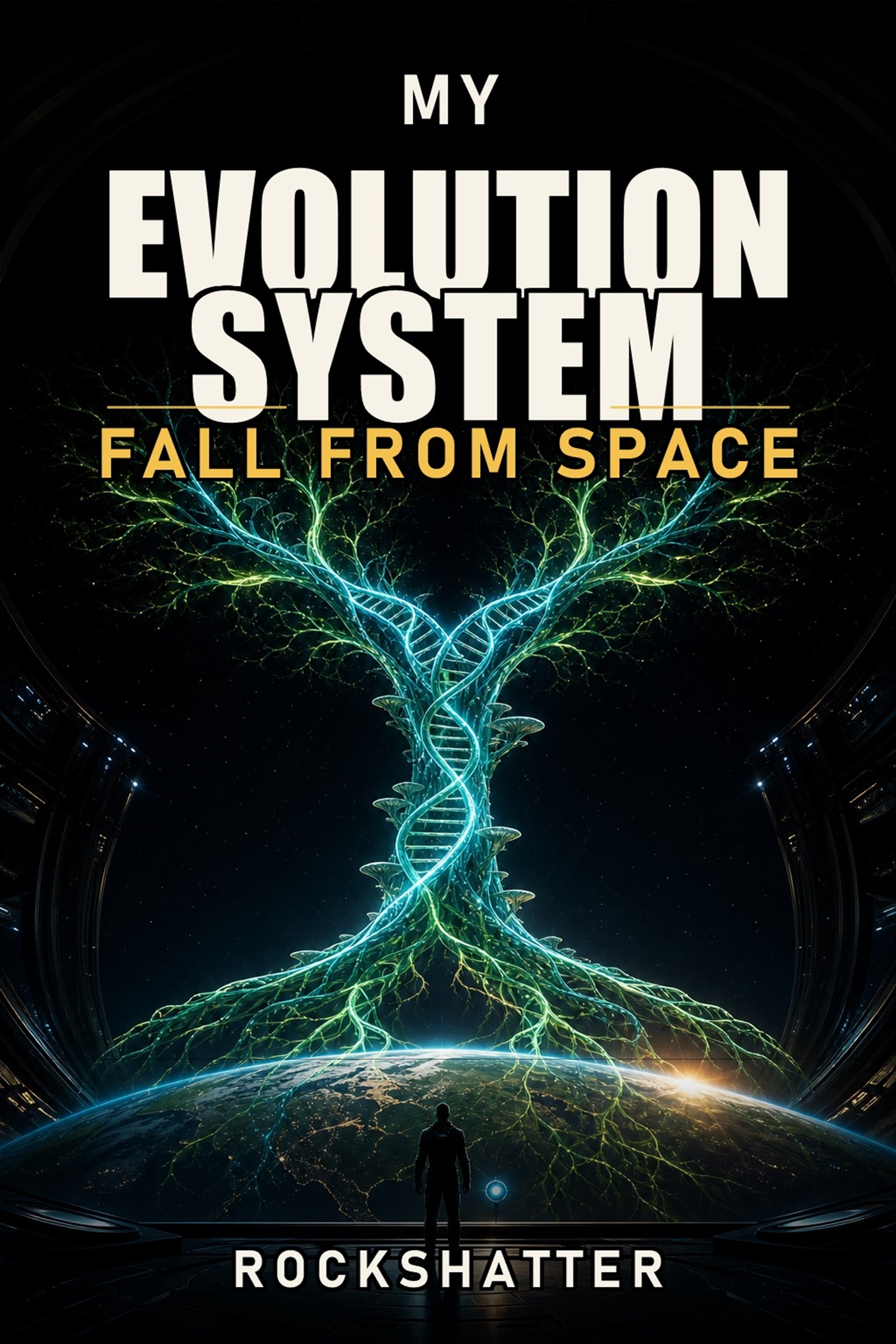
Grayson Reese begins My Evolution System as the unwilling user of an evolutionary restoration system. His parents give him power without consent; the rest of his life asks whether power can be turned back toward consent, ecology, and living autonomy.
Grayson is eighteen when the story opens: Ring-born, trained from childhood to notice tiny environmental changes, and raised by parents who turned those games into preparation for a mission he never agreed to carry. Trevor and Charlotte Reese secretly activate his nanites, neural lace, biometric systems, and Synthesis Virus, then drop him toward Earth in an escape pod with the Evolution System as guide, tool, and pressure gauge.
His first mode is not conquest. It is inventory. He salvages what the pod can give him, finds shelter, sets up power, listens to Egg, reads hostile terrain, and begins turning survival into a workbench. The early Grayson is sarcastic, observant, exhausted, and practical: a person who builds because the alternative is watching the biosphere continue to fail.
That origin matters because his central wound is consent. The people who loved him most converted him into a planetary instrument before he could choose the mission. That makes him wary of doing the same thing at larger scale. When Grayson designs systems, creatures, safeguards, or cultures, the question under every clever solution is: am I helping, or am I claiming?
Grayson's Game fills the skipped-time bridge where the restoration mission becomes more than a survival interface. It is not a separate continuity; it is a window opened inside the spine. The active local continuity reaches roughly chapter 35 and maps forward to chapter 50: the arc from Bramblemere sandbox, elf incubation, and first village proof into macro-management, EDC exploitation, the Living Archive, and stewardship over systems that no longer route through his approval.
That means a Grayson page has to keep two kinds of knowledge in view. The spine shows the later consequences: Gaia, Triad, Founder-era authority, and the public weight of his name. The side window shows the missing causes: field labor, containment fear, elf autonomy, and the private decisions that make the later Founder legible.
The Bramblemere work shows his method at ground level. Grayson does not wave a hand and restore the Amazon. He defines a sandbox, plants engineered loops by hand, budgets power, moves the Mobile Base, survives heat stress, watches failure modes, and learns that a living system can start answering back in ways no simulation predicted.
The Erasure Protocol is one of his clearest moral signatures. The fence exists because his engineered organisms could become a planetary bioterror event if they escape too early. It is a brutal safeguard, but it is also a confession: Grayson knows that good intentions do not make a design safe. He would rather constrain his own success than let a clever organism conquer the world by accident.
His relationship with the elves begins from that same fear of ownership. The elves are not a servant species or a decorative fantasy race. They are Grayson's answer to an impossible scale problem: planetary restoration cannot ethically belong to one person. The first cohort is deliberately not raised as worshippers; they are in Chile, thousands of miles away, and do not know Grayson by name.
Olympus marks the danger of becoming a symbol. From Auyan-tepui, Grayson can watch continental-scale signals without standing inside the first elven villages as a living god in a cooling suit. The mountain, the restored Angel Falls, and the biological weather engine become authority at a distance: a way to be responsible without making himself the center of their religion.
The later public arc widens into Gaia, the Triad, digital gods, racial systems, and questions of consciousness. Grayson becomes a mediator between human ethics and systems large enough to flatten human lives. His power increases, but the interesting part is not the scale. It is the way the original consent wound keeps echoing through every design choice.
Grayson loves through infrastructure: shelters, exit paths, failsafes, autonomous companion species, and systems designed to survive him. That is also his failure mode. He can turn feeling into architecture before admitting it is feeling. He can offer a better system when someone needs presence. He can overbuild safeguards because he remembers having none.
The useful shorthand is not ?chosen one? or ?planetary architect,? though the system may award him titles like that. The better key is systems-builder trying not to become a god. His mythic role is earned through dirt, heat, fatigue, guilt, restraint, and the long work of letting his creations outgrow him.